AICE Certified Educator Badge
AI Competency for Educators
What this handbook provides
- Criteria and expectations for earning the AICE Certified Educator Badge.
- An overview of the AICE Framework’s four competency dimensions: Functional, Content, Pedagogical, and Ethical.
- Practical guidance and examples for integrating AI along AICE Framework dimensions into instructional practices, curriculum and content development, and other professional activities.
- Resources and support for continued professional growth.
Authors
- Alex Liu, alexliux@uw.edu
- Dr. Min Sun, misun@uw.edu
Prepared by
- Colleague AI Research and Development Team
- University of Washington
AICE (AI Competency for Educator) Certified Educator Badge Description
Celebrating confident, creative, and responsible AI use in teaching
The AICE Certified Educator Badge, offered by the University of Washington in collaboration with Colleague AI, recognizes educators who have shown they can use AI as a powerful teaching partner, not just for planning, but for designing great lessons, supporting every kind of learner, and modeling safe, responsible use for students.
What It Means
When you earn this badge, it means:
- You can move confidently between different AI tools and choose the right one for the job.
- You find, adapt, and improve AI-generated materials so they work for your students.
- You use AI to create well-structured, engaging lessons, and bring those ideas into the classroom.
- You protect student privacy, check for fairness, and teach students how to use AI wisely.
Why It Matters
Earning this badge means you’ve built a modern teaching skill set that helps you:
- Save time without lowering quality.
- Reach every learner with customized scaffolding.
- Prepare students for a world where AI is part of everyday learning and work.
This badge shows your school, your colleagues, and your professional network that you are ready to lead in AI-supported teaching.
How You Earn It
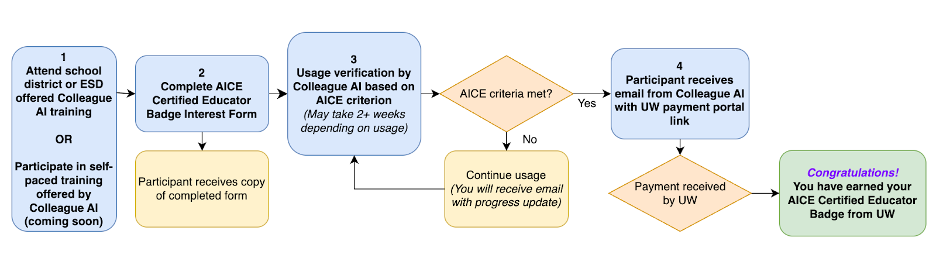 During step 3 verification process, you will work toward the badge on Colleague AI by showing:
- Functional Skills – You use multiple AI features with ease and match the tool to the task.
- Content Skills – You retrieve, adapt, and fact-check AI content so it’s accurate, relevant, and inclusive.
- Pedagogical Skills – You design and deliver lessons that use AI to improve learning and engagement.
- Ethical Skills – You model safe, fair, and transparent AI use for your students.
We measure this through your real use of the platform, the features you try, the prompts you write, and how you adapt AI output for your context. Go to section Your AI Competency Rubric for more information.
AI Competency for Educators (AICE) Framework: Defining and Developing Practical AI Competency in Education
“The AICE Framework affirms a simple truth: AI is only as transformative as the educators’ ability to use it with purpose and precision.”
As artificial intelligence (AI) technologies become more embedded in the tools educators use every day, a new set of professional responsibilities has emerged for educators. AI now supports a wide range of instructional activities—from lesson planning and assessment design to feedback, content curation, and teacher-student interaction. While these tools can improve instructional quality, their impact depends not on the tool itself but on the educator’s ability to use AI in intentional, ethical, and pedagogically grounded ways.
What Does It Mean to Be AI-Competent as an Educator? To answer this question, the Colleague AI research team at the University of Washington introduces the AICE Framework: Advancing Instructional Capacity with Educators through AI. AICE is a research-based, growth-oriented model that defines and supports educator AI competency, with an emphasis on actionability, sustainability, and instructional integration.
Why Do We Need AICE Framework?
AICE is developed to be an observable and actionable framework that scaffolds the growth of educators’ AI competencies, ensuring that the integration of AI is not just technical but instructional. The AICE Framework empowers educators to unlock the full pedagogical value of AI tools and maximizes the impact of school and district investments in AI by turning educational technology into measurable gains in teaching and learning.
While much of the recent attention has focused on AI literacy for students or on broad ethical considerations, the role of educators in this shift is under-examined. Educators are increasingly expected to interpret, adapt, and implement AI-generated outputs, often without sufficient structured and targeted support.
Several existing frameworks emphasize conceptual understanding and ethical awareness. While these are crucial, they often remain at a declarative level (what educators should know), rather than guiding how educators operate AI-powered tools in professional contexts.
AICE fills this gap by defining AI competency through four interrelated dimensions of professional practice, offering a structured and practice-based framework for educators. Each dimension is grounded in practice, informed by research, and designed to scale across educational settings.
-
Educator Growth-Oriented: Each dimension is translated into observable and teachable competencies, enabling actionable feedback and ongoing professional learning.
-
Instructionally Grounded: The framework prioritizes enhancing teaching and learning, rather than focusing solely on technical proficiency.
-
Measurable and Scalable: Competencies can be tracked through platform usage logs and aligned with strategically designed training programs. Insights from implementation inform professional development, tool design, and broader system-level adopting strategies.
-
Practice-Driven: The framework emphasizes demonstrated instructional practices that reflect AI competency, beyond mindset or attitudes, anchoring growth in what educators actually do.
Figure. Significance of AI Competency for Educators (AICE) Framework
The Four Dimensions of AICE
The AICE Framework outlines four dimensions that guide educators in using AI tools intentionally, ethically, and in ways grounded in sound pedagogy. Together, these dimensions make AI integration both measurable and scalable, affirming a simple truth: AI is only as transformative as the educator’s ability to use it with purpose and precision.
1. Functional: Operational Proficiency
Definition: Educators demonstrate fluency in navigating and applying AI tools for instructional and professional tasks.
-
F1. Tool Fluency: Educators can confidently operate AI-enabled tools (Colleague AI or others) and tools relevant to their instructional context.
-
F2. Purposeful Application: Educators can identify and match appropriate AI tools/features to specific instructional or professional tasks.
This foundational layer ensures educators can consistently and skillfully engage with AI as part of their professional toolkit. This dimension establishes the technical foundation required for more pedagogically and ethically sophisticated uses of AI.
2. Content: Contextual Adaptation
Definition: Educators use AI to access and transform content in ways that are relevant, coherent, and aligned with instructional needs.
-
C1. Content Retrieval: Educators can obtain instructional materials, insights, and data from AI systems aligned with curriculum goals.
-
C2. Instructional Adaptation: Educators can reshape AI-generated content into formats, modalities, and tones suitable for their specific classroom, student needs, and institutional goals.
-
C3. Critical Inspection: Educators can critically evaluate the accuracy, usefulness, and relevance of AI-generated content and operate AI tools to revise and refine the content.
AI-competent educators are not passive content consumers; they critically reframe and customize AI outputs for their own educational context.
3. Pedagogical: Instructional Enhancement
Definition: Educators integrate AI to improve instructional design and delivery, student engagement, and professional efficacy.
-
P1. Pedagogical Design: Educators use AI to inform and refine instructional sequencing, modality selection, and alignment with learning objectives, improving lesson quality and classroom delivery.
-
P2. Instructional Integration: Educators enhance student learning and engagement by embedding AI tools into lesson planning, delivery, and assessment.
-
P3. Professional Optimization: Educators use AI to advance on-job professional learning outcomes, improve evaluation performance, and fulfill a more balanced set of professional obligations across disciplinary, individual, institutional, and societal responsibilities.
This dimension positions AI not just as a standalone tool, but as a collaborator in instructional and professional improvement.
4. Ethical: Responsible Use and Modeling
Definition: Educators ensure the responsible use of AI and model ethical digital practices for students.
-
E1. Responsible Operation: Educators manage AI use in compliance with ethical norms and institutional code of conduct, such as data privacy, transparency, and accessibility.
-
E2. Ethical Modeling: Educators reflect on their own AI use to guide students in developing ethical reasoning and responsible digital behaviors in AI-supported environments.
-
E3. Critical Inspection: Educators can critically evaluate AI responses and identify and correct biases and misinformation in the generated information.
Educators are not only AI operators. They are ethical stewards, modeling what thoughtful, human-centered AI use looks like for their students.
Framework Foundations
The AICE Framework integrates and builds upon three foundational bodies of work:
-
AI Literacy Framework (Stanford Teaching Commons): Emphasizes understanding of AI’s functions, ethical concerns, and instructional applications. This framework has been inspired by Miao and Cukurova’s AI competency framework for teachers (AI CFT), which is intended to support the development of AI competencies among teachers to empower them to use these technological tools in their teaching practices in a safe, effective and ethical manner.
-
Professional Obligation in Enacting Curriculum (Herbst & Chazan, 2020): identify educators’ responsibility to discipline, students, institutions, and society. This theoretical foundation helps us position AI use within the set of professional obligations.
-
Instructional Core (City et al., 2009): Highlights the dynamic relationship between teacher, student, and content as the engine of learning outcomes.
These anchors ensure the AICE Framework is both aspirational and actionable, linking new technologies to enduring principles of instructional quality and teaching effectiveness.
Implications for Practice
- For Teachers and Coaches: AICE can inform self-assessment tools, professional learning pathways, and micro-credentials focused on AI integration.
- For Professional Development Designers: Each AICE competency provides a unit of learning that can be scaffolded across beginning, intermediate, and advanced stages of AI use.
- For Tool Designers: The framework offers design principles for building educational AI tools that are transparent, adaptable, and instructionally and professionally relevant.
- For System Leaders and Policymakers: AICE can guide certification criteria, district AI-readiness strategies, and equity-focused implementation roadmaps.
In the following sections, you will find information about AICE competency badges, along with a detailed explanation of the badging criteria and practical guidance for each dimension of the AICE Framework.
Integrating the Four Dimensions of AICE into Practice
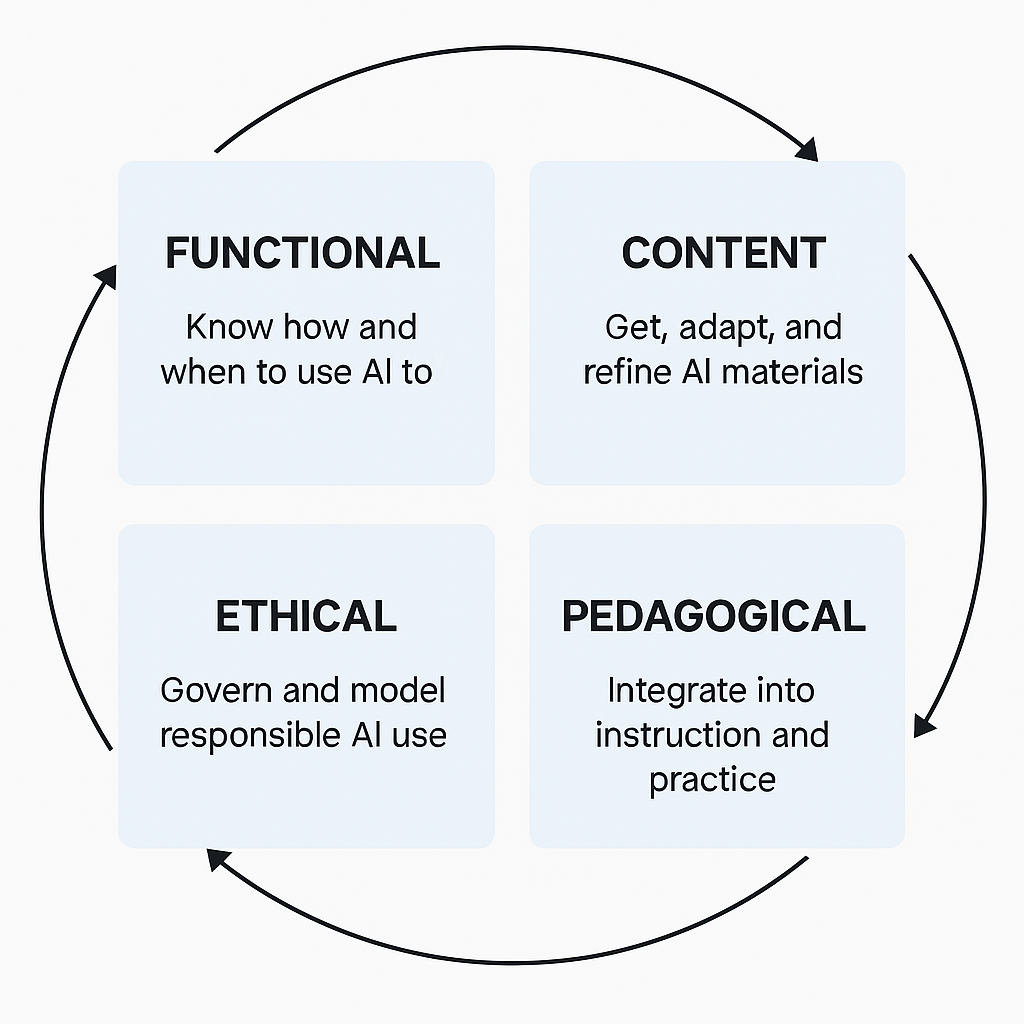
In the AICE framework, the four dimensions—Functional, Content, Pedagogical, and Ethical—are not isolated skill sets. They form an interdependent system, where growth in one dimension strengthens and relies on the others. The interplay looks like this:
1. Functional → Content
- Functional skills (F1 Tool Fluency, F2 Purposeful Application) give educators the operational capacity to use AI tools effectively.
- Without these skills, Content competencies (C1-C3) cannot be realized, because retrieving, adapting, and evaluating AI content depends on knowing how to access and control the tools in the first place.
Example:
An educator who knows how to navigate Colleague AI (F1) and select the right feature for lesson creation (F2) can then retrieve standards-aligned materials (C1) from the lesson generator and adapt them for their class (C2) in AI chat.
2. Content ↔ Pedagogical
- Content skills supply the raw and refined instructional materials that Pedagogical skills transform into effective learning experiences.
- Mastery in C3 (critical inspection) ensures the materials going into lesson planning (P1), classroom integration (P2), and professional optimization (P3) are high quality.
Example:
Accurately adapted and fact-checked AI-generated case studies (C2-C3) are then sequenced into a lesson plan with actional engaging strategies and appropriate modalities (P1) and used in a live classroom student-AI discussion (P2).
3. Pedagogical ↔ Ethical
- Pedagogical use of AI directly impacts student experience, so Ethical skills safeguard its fairness, accessibility, and transparency.
- Ethical reflection (E2) and inspection (E3) improve the quality and trustworthiness of AI-supported instruction, while responsible operation (E1) ensures it aligns with policy and norms.
Example:
When integrating an AI-powered formative quiz (P2), the educator applies E3 to check for bias in testing questions and E1 to ensure no student data privacy rules are violated.
4. Ethical → Functional and Content
- Ethical competencies shape how Functional and Content skills are applied.
- An educator may be technically fluent in AI tools (F1) and skilled in retrieving content (C1), but ethical aspects (E1-E2-E3) ensures those skills are used responsibly and in ways that model best practices for students.
Example:
Choosing not to use a certain AI summarization feature because it mishandles sensitive student data, despite knowing how to operate it, is an Ethical decision guiding Functional practice.
5. The Continuous Loop
You can think of the four dimensions as a cycle:
- Functional: Know how and when to use the tools.
- Content: Get, adapt, and refine the materials.
- Pedagogical: Integrate them into instruction and professional practice.
- Ethical: Govern and model responsible, equitable, and transparent use.
The loop restarts as each cycle of AI-supported work builds both competence and judgment for the next.
Your AI Competency Rubric
(Evaluated over the past 15 days of your Colleague AI use)
We look at your platform behavior, including the features you use, the prompts you write, and the way you adapt AI output, to see how AI is supporting your teaching, planning, and professional work.
We are not testing your technical skill with computers. Instead, we are looking at how AI is used to make your work stronger, easier, and more effective.
1. Using the Tools (Functional Skills)
What we look for:
- How many different AI features you use.
- Whether you choose the right feature for the job.
| Level | What We See in the Data | How to Grow |
|---|---|---|
| Getting Started | You stick to one tool most of the time. | Try one new feature you have not used before (e.g., Generate Rubrics, Simulate a Lesson Plan, Generate Slides, Generate Podcast). |
| Confident | You use several features and usually pick the right one for the task. | Build short “chains”--use 2-3 features in a row for one goal (e.g., Brainstorm Ideas → Lesson plan chat in my document → generate interactive quiz). |
| Expert | You move easily between many tools and combine them into smooth workflows. | Share your favorite workflows with colleagues. |
2. Working with Content (Content Skills)
What we look for:
- How you find AI-generated materials that match your subject, grade, and goals.
- How you adapt AI output for your students.
- How you check for factuality and accuracy.
| Level | What We See in the Data | How to Grow |
|---|---|---|
| Getting Started | You use AI’s first draft without much change. Your conversations usually stop with one or two iterations. | Add grade, subject, and learning goal to your prompts; make one small change for your students before using it. |
| Confident | You actively adapt AI content for your educational context (e.g., grade, subject, classroom environment) or change the format. | Combine two changes at once (e.g., adjust reading level + make it a table). |
| Expert | You regularly adapt for various learning needs and styles (e.g., mastery levels, visual learners, MLL, IEP). You check accuracy and ask for modifications. | Model your checking process and prompt strategies for students or peers. |
3. Designing and Teaching (Pedagogical Skills)
What we look for:
- Whether you use AI to design well-structured lessons.
- Whether AI output reaches your students (not just planning).
- Whether AI helps you with professional growth tasks.
| Level | What We See in the Data | How to Grow |
|---|---|---|
| Getting Started | AI use is mostly for single profession aspects (e.g., content and curriculum), not for | Turn one AI output into a student-facing activity or resource this period. |
| Confident | You create lessons with clear structure and some student-facing AI materials. | Add interactive elements or class discussion prompts to AI resources. |
| Expert | You integrate AI into live teaching, adapt in real time, and use AI for PD and evaluation. | Share your live AI use examples in PD or coaching sessions. |
4. Using AI Responsibly (Ethical Skills)
What we look for:
- That you protect student privacy.
- That you avoid biased or inappropriate content.
- That you show students how to use AI responsibly.
| Level | What We See in the Data | How to Grow |
|---|---|---|
| Getting Started | Little or no evidence of privacy checks. | Avoid sharing identifiable student information in prompts. |
| Confident | You avoid privacy risks and sometimes check for fairness and accessibility. | Add a bias check to at least one AI resource per period. |
| Expert | You regularly check for bias, verify facts, and explain your choices to students. | Lead a short activity where students practice checking responsible and critical AI usage modeled after your practice. |
How We Measure This
- From your training participation: You complete one of the following options
- Institution offered Colleague AI training
- Colleague AI self-paced online training ethical module
- From your prompts and conversations: We look for certain teaching moves (like adapting for MLL or fact-checking) in the text you write and the AI replies you use.
- From your feature use: We count how many different tools you try and whether they match the task you’re working on.
- From your teaching context: If you work with MLL, SPED, advanced, or struggling learners (based on your profile input), we look for prompts and activities tailored to them.
Mapping DuFour PLC vs. PLC+ onto AICE Dimensions
| AICE Dimension | DuFour PLC – Suggestions for Educator Support | PLC+ – Suggestions for Educator Support |
|---|---|---|
| Functional (Tool Fluency & Purposeful Application) | • Provide common assessments, shared pacing guides, and standardized data systems.• Train educators to analyze assessment data collaboratively.• Emphasize consistency in tools and procedures to monitor student learning.• PLC meeting structures are highly standardized (agendas, data cycles). | • Ensure access to disaggregated student data (by subgroup, equity categories).• Provide training on interpreting multiple forms of evidence (student work, perceptions, SEL indicators).• Encourage flexible tool use—teachers choose evidence that best reflects their students’ needs.• Structures are adaptive to reflect context, not only standardized. |
| Content (Retrieval, Adaptation, Critical Inspection) | • Focus content discussions on unpacking standards (“What do we want students to learn?”).• Align team-developed lessons and assessments to standards and pacing.• Emphasize consistency of curriculum across classrooms. | • Extend content discussions to who is learning and who is left behind.• Adapt curriculum with an equity lens—culturally responsive resources, multiple modalities.• Inspect evidence beyond tests (student voice, engagement, SEL data).• Encourage content flexibility to meet diverse learners. |
| Pedagogical (Design, Integration, Optimization) | • Collaboratively design lessons and interventions for students who don’t meet benchmarks.• Share “best practices” among teams (model lessons, intervention strategies).• Interventions/extensions are often pre-set or standardized across the PLC. | • Pedagogy framed as inquiry cycles (What strategies worked? For whom?).• Encourage teacher experimentation and innovation in lesson design.• Incorporate trauma-informed, culturally responsive, and student-centered practices.• Emphasize collective efficacy: “Together, we can reach every learner.” |
| Ethical (Responsible Use & Modeling) | • Accountability focus—teachers are collectively responsible for results.• Less explicit attention to equity, bias, or student identity (implicit assumption: same interventions work for all).• Equity often addressed indirectly through results monitoring. | • Explicitly surface equity and bias in instructional design and outcomes.• Incorporate reflection on teacher impact (How do my practices advantage some and disadvantage others?).• Build norms of agency, transparency, and inclusion in PLC culture.• Position educators as ethical leaders modeling fairness and responsibility. |
Resources and Ongoing Professional Growth
- University of Washington AICE Certified Educator Badge information page
- AICE Certified Educator Badge Interest Form. You must complete either institution-offered Colleague AI training or the Colleague AI self-paced training (Ethics Module or Full Module, based on the position test) before filling out the interest form. Please check with your school district or ESD for Colleague AI PD opportunities. We will also share updates through our social media channels and newsletters.
- Practical AI Toolkits for Educators
- Colleague AI self-paced Canvas training set: coming soon
- For organizational PD organizers, book a meeting with the Colleague AI team to co-design training that aligns with the framework.